Why did Napoleon Built The Arc de Triomphe?
The Arc de Triomphe is one of the most iconic monuments in Paris, located at the western end of the Champs-Élysées.
For many visitors, it’s just another must-see landmark in the French capital.
But beyond its impressive size and perfect symmetry, the Arc de Triomphe carries a deep political, military, and symbolic meaning.
Its construction is directly tied to Napoleon Bonaparte’s vision of power, glory, and legacy.
So why did Napoleon build the Arc de Triomphe?
The answer lies in his ambition to immortalize military victories, glorify the French army, and place himself in the long tradition of great rulers of history.
The Historical Context: France Under Napoleon
At the beginning of the 19th century, France was emerging from the chaos of the French Revolution.
The monarchy had fallen, Europe was politically unstable, and France was at war with several major powers.
In this turbulent environment, Napoleon Bonaparte rose rapidly through the military ranks, becoming First Consul in 1799 and Emperor of the French in 1804.
Napoleon understood the power of symbolism.
He believed that monuments, art, and architecture could shape public memory and reinforce national pride.
Just as ancient emperors used grand structures to legitimize their rule, Napoleon wanted physical reminders of his authority and achievements scattered across Paris.
The Battle of Austerlitz: The Moment That Changed Everything
The decision to build the Arc de Triomphe was inspired by one of Napoleon’s greatest military triumphs: the Battle of Austerlitz, fought on December 2, 1805.
Often referred to as the “Battle of the Three Emperors,” Austerlitz saw Napoleon’s army defeat the combined forces of Austria and Russia.
The victory was decisive and confirmed Napoleon as one of the greatest military strategists in history.
Shortly after the battle, Napoleon promised his soldiers that they would return home “under triumphal arches.”
This promise would soon take physical form in the heart of Paris.
When Was the Arc de Triomphe Built?
Construction of the Arc de Triomphe officially began in 1806, just one year after the victory at Austerlitz.
Napoleon personally chose the location at the top of the Champs-Élysées, at what was then known as Place de l’Étoile (now Place Charles de Gaulle).
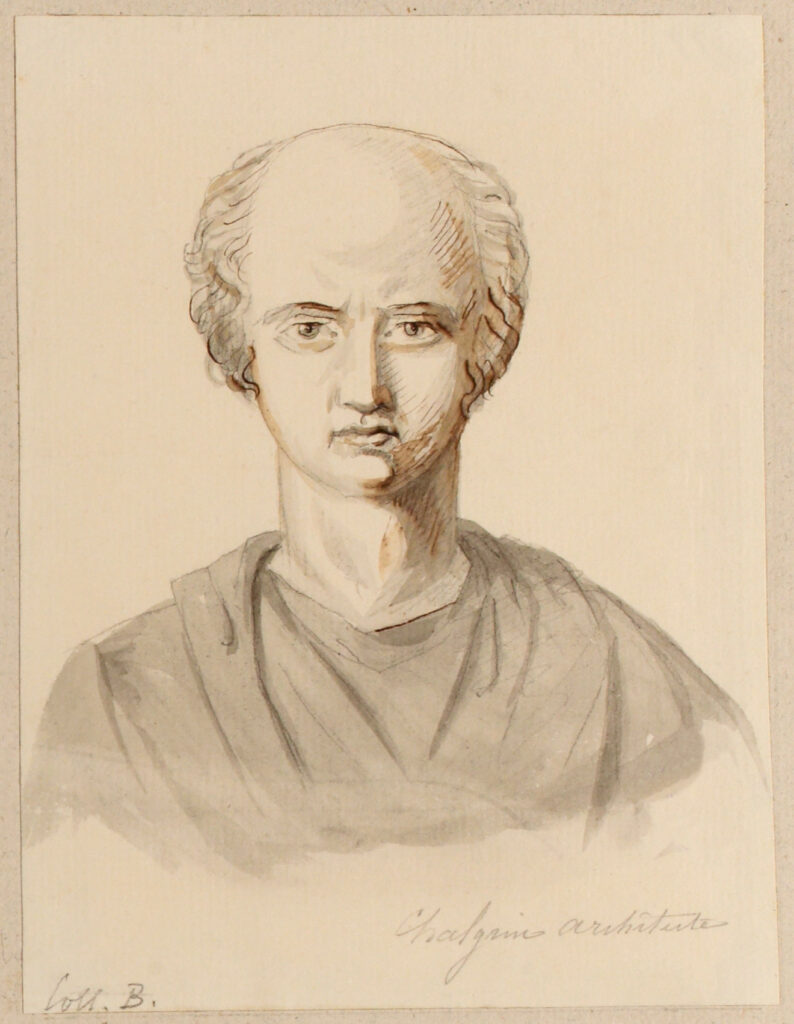
The architect Jean Chalgrin was commissioned to design the monument.
His vision was inspired by the triumphal arches of Ancient Rome, particularly the Arch of Titus, which celebrated Roman military victories.
However, despite Napoleon’s urgency, construction progressed slowly.
Chalgrin died in 1811, and political events soon disrupted the project.
Inspired by Ancient Rome
Napoleon was deeply fascinated by Ancient Rome. He saw himself as a modern-day Caesar, leading a powerful empire and reshaping Europe.
Roman triumphal arches were built to commemorate victories and honor generals, and Napoleon wanted to place himself in that same historical lineage.
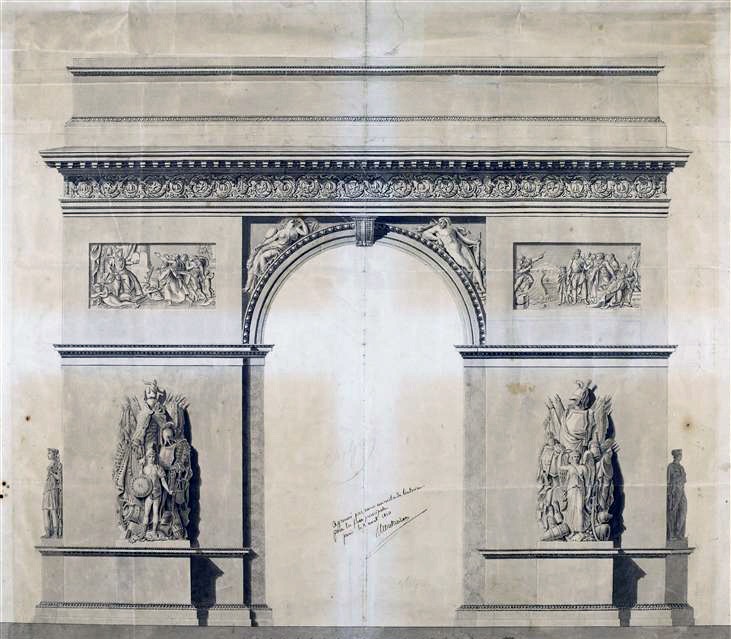
The Arc de Triomphe follows classical Roman architectural principles: massive proportions, sculpted reliefs, and inscriptions celebrating military achievements.
The difference is scale; Napoleon’s Arc was designed to be larger and more imposing than its ancient predecessors.
In this way, the monument was not only about France’s victories, but also about Napoleon himself and his desire to be remembered as a legendary ruler.
A Monument to the Grande Armée
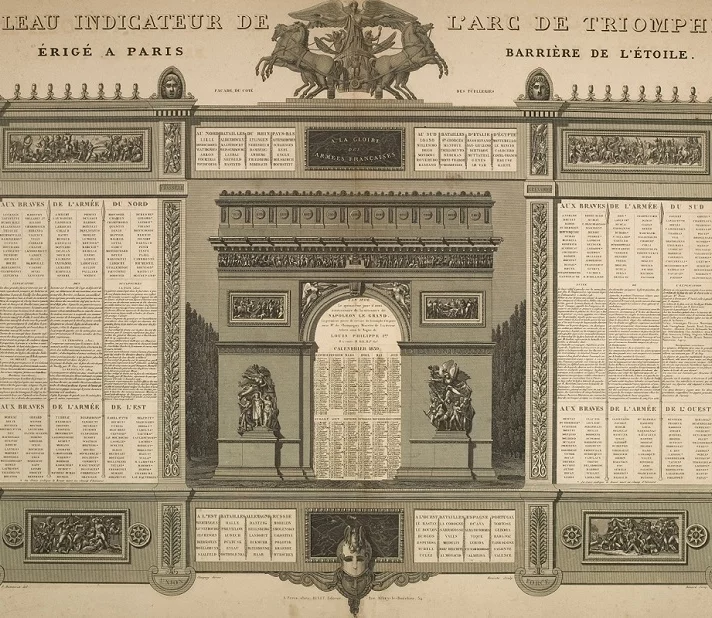
Although often associated with Napoleon personally, the Arc de Triomphe was officially dedicated to the Grande Armée, the French army that fought in the Revolutionary and Napoleonic Wars.
The names of 558 generals are engraved on the monument, along with the names of major battles won by France.
Generals who died in combat have their names underlined, emphasizing sacrifice and heroism.
This focus on the army helped strengthen national unity and military pride, reinforcing the idea that France was a dominant force in Europe.
A Project Interrupted by History
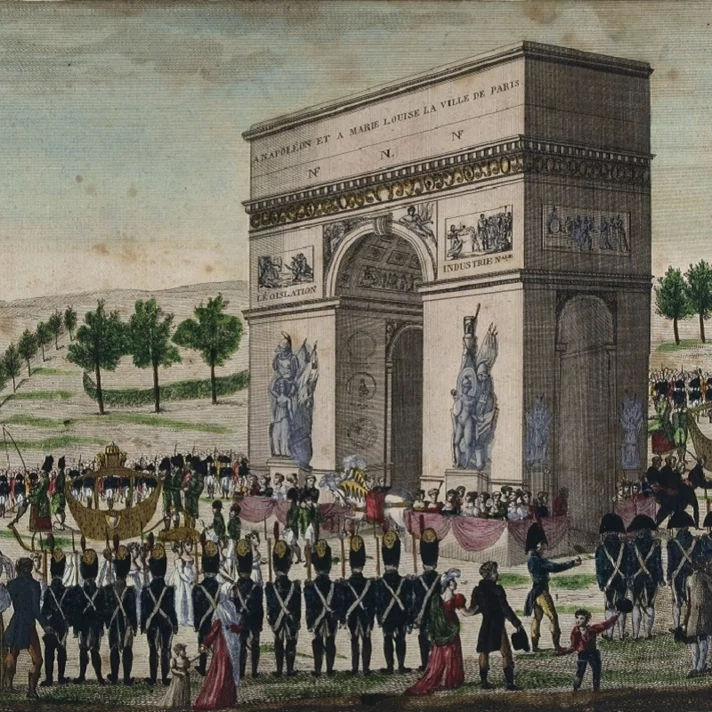
Napoleon never lived to see the Arc de Triomphe completed.
After suffering major defeats, including the disastrous invasion of Russia in 1812, Napoleon was forced to abdicate in 1814.
With the fall of the Empire and the restoration of the monarchy, construction on the Arc de Triomphe was temporarily halted.
Ironically, when Napoleon’s funeral procession passed under the unfinished arch in 1840, it symbolized both his grand ambitions and his ultimate downfall.
Completion Under a New Regime
The Arc de Triomphe was finally completed in 1836, during the reign of King Louis-Philippe, thirty years after construction began.
By then, its meaning had evolved.
While it remained a monument to military victories, it also became a symbol of national reconciliation.
Rather than celebrating one man, the Arc came to represent the broader history of France and its soldiers.
This transformation helped ensure the monument’s survival through political changes, revolutions, and regime shifts.
From Imperial Symbol to National Monument
Over time, the Arc de Triomphe took on new layers of meaning.
In 1921, the Tomb of the Unknown Soldier was placed beneath the arch to honor those who died in World War I.
An eternal flame burns there to this day, connecting Napoleon’s era to modern French history.
The Arc is now central to national ceremonies, including Bastille Day military parades and commemorations of wartime sacrifice.
Why the Arc de Triomphe Still Matters Today?
Today, the Arc de Triomphe stands not only as a reminder of Napoleon’s ambition but also as a symbol of France’s complex relationship with power, war, and memory.
Its Roman inspiration reflects Napoleon’s desire for immortality, while its long construction and evolving purpose show how monuments can outgrow their original intentions.
What began as a celebration of one man’s victories has become a shared national symbol.
Final Thoughts
Napoleon built the Arc de Triomphe to honor military triumphs, glorify the French army, and place himself in the lineage of ancient emperors.
Inspired by Roman architecture and born from the victory at Austerlitz, the monument was meant to immortalize his legacy.
Although Napoleon never saw it finished, the Arc de Triomphe ultimately achieved what he intended: it ensured that his name, his army, and his era would never be forgotten.
Standing beneath it today, visitors aren’t just admiring a monument; they’re witnessing a powerful statement of history, ambition, and memory carved in stone.